In our times when climate extremes are challenging the balance of nearly every ecosystem on Earth, it is certainly not the time to hinder even further the balance of Nature. By doing so we continue to tip the scales before Nature has a chance to regain her footing. But somehow, threats to ecological balance has become an ongoing, normalized human pastime.
On June 20th, a human-caused fire started less than a half a mile from where I live. The fire grew swiftly as massive howling winds blew in our direction. In no time I could hear the roaring of the inferno cloaked in smoke as it grew in intensity. It advanced upon us so quickly we barely had enough time to evacuate. Gratefully, my partner, dog and I made it out safely. At the time however, we didn’t quite know to what extent the event might turn into. Ourselves, the neighbors and the small mountain community we belong to were extremely lucky in many ways.
Sadly, what we thought could be a possibility became a reality. My concerns surrounding increased forest fire risk piqued last Fall when the Bureau of Land Management (BLM) conducted a forest thinning of approximately 450 acres, in areas directly surrounding where I live. After expressing my concerns to the BLM and learning some alarming details concerning what vegetation was supposed to be targeted versus what actually took place at the hands of under-supervised sawyers, my concerns deepened. Those concerns deepen even further when we soon found ourselves surrounded by hundreds of acres of abandoned debris of slash and brush. Undeniably however, it was this particular debris which contributed to just how quickly the fire spread; and a human, unfortunately, was the ignitor, as there had been zero lightning storms present at the time.
The slash and brush which was left exposed to dry over winter and spring, scattered about by the BLM-hired thinning crew become the hungry inferno’s perfect fuel turning this fire into the threatening event that it was. As a result, roughly 40% of our 20 acre land suffered, according to a lead firefighter, a mix of medium to low-intensity burns. And over 420 acres of the beautiful surrounding public forest suffered a mix of high, medium and low-intensity burns. Even while our land suffered the consequences of this disturbingly unnatural occurrence, it will recover but, there is one thing we know to be true…. this didn’t have to happen.
My partner and I have always accepted wildfires as a natural part of living with the forest. What we find hard to accept however, is how this particular fire could have been avoided in two ways. Firstly, the thinning and slash left behind was a grossly inappropriate action taken on behalf of the Bureau of Land Management. An utter failed attempt at “fuels management”. Observations of wildfires occurring in the west plainly reveal, forests destructively meddled with in these ways tend to spread more quickly and burn more intensely, especially when natural ecological balance is so abruptly stolen from Nature. Secondly, the fire, which was named the Rico fire, was a human-caused fire. This man-caused and fed-fueled fire sets an disturbing tone for the world we now find ourselves living in.
Alarmingly, post-fire, there is still roughly 40-60 acres worth of this dry cut debris laying across the forest ground, most of which lies directly outside our property’s eastern fence-line, an area the fire did not consume.
We are in a drought and were in our dry and windy season when the fire took place, yet, during the same week of this fire, our neighbor witnessed two separate groups of campers near where the fire started. One of which left behind a smoldering fire-ring which he so appropriately drowned out. Campfires and the like should not even been considered at this time yet, we are living in times at the mercy of great human unconsciousness. Whereby human beings of this earth cannot even discern whether natural conditions at such a present time would be unsafe for a campfire or not. One need only to look around their natural surroundings, hear the crackle of dry litter underfoot and feel the gust of dry, hot air slap across their face to realize what is so. Albeit, there are other suspicions of how exactly a human ignited this particular fire, which is under investigation and remains to be determined.
Initially we were told by the BLM that the thinning operation was part of a ponderosa recovery protocol. However, the so-called “ponderosa recovery”, which was simply a fuels management protocol, did nothing to improve ecological resiliency, nor did it achieve a reduction in wildfire risk. In fact it did quite the opposite.
The operation accounted for around three months of noisy, fume-emitting, destructive chainsaws and consumed both natural and fossil fuel resources and wasted efforts which actually ended up compromising the forest ecology and increasing fire danger.
When we were initially told this was a ponderosa recovery protocol, we were extremely perplexed by just how many ponderosas were being targeted. Baby ponderosa as small as only two feet tall were even indiscriminately zipped dead by sawyers. In fact baby ponderosas and towering ponderosas and every size in between were targeted. What’s even more perplexing is that in some areas throughout the 450 or so, of treated acres, ponderosas were targeted so heavily the treatment left behind sparse stands of emory oak and alligator junipers. Unfortunately, it takes knowing the area well enough to find these parcels of forest left with this pattern.
More often, historical suppression fires and other natural processes by humans lead to dire consequences for generations of forests that follow. By State and Federal standards, the actions of thinning are far too often not for the benefit of the forests themselves, but to meet the demands of sprawled humans and human communities. In attempts to quell human fears of natural processes, the modern rationale is to prevent fires altogether. A rationale actually goes essentially something like this, we are scared of forest fires, therefore, lets get rid of forests. It’s a way of thought that does not sit well with me. As a result, many of our forests aren’t the robust forests they once were, lacking the diversity and richness that otherwise give them their resiliency.
The effects of climate change aside, the unfortunate truth is that human efforts to manipulate forests and suppress naturally occurring, low-intensity forest fires whether it be by mechanical removable, chemical applications like herbicide and/or grazing has actually contributed to increased incidence of high-intensity wildfires in more modern times. In response to our “pyrophobia” humans have actually made things worse. There are many reasons why this is. For one thing, opening up the forest understory so abruptly allows for more wind tunneling and exposure from the sun which further dries out any understory debris, which makes perfect for kindling. In the case of the Rico fire, the alarming amount of the cut and dried fluffy slash left scattered throughout the entire treated area was that perfect kindling.
All these factors combined compromise the ecology of our public forests. Simply put, we are making the forests we have left, drier. Period. These actions, alongside climate changed, are a recipe for ongoing disasters. Truly, the only places where thinning is optimal is directly surrounding homes and other buildings. This is called being fire-wise. Fire-wising in this way would not only save homeowners a ton of money, but would also spare national budgets that could be spent in other beneficial ways. Rather our world continues to be in great need of allocated budgets for restorative efforts, not destructive ones.
Furthermore, not only does thinning initially cause winder, hotter and drier conditions, it can also lead to thicker underbrush since already established root systems will continue to uptake moisture and nutrition, even when just a stump is left. Let’s take the silverleaf oak, for example, which the protocol did intend to target. When trees like the silver leaf oak are cut, no matter how small, shoots will eventually grow back along the perimeter of the base of the cut trunk. So what results is a denser shrub-like version of an otherwise singular oak tree. How land management agencies like the BLM and Forest Service try to combat this is to apply herbicide to tree stumps. Personally, I don’t know what is more disturbing, recklessly cutting down our public forests in the first place, or polluting our natural environment with chemicals.
As a self-governing entity, Nature knows best. But, we’ve gotten in Nature’s way. There are indeed many ways humans are needed to oversee and protect Nature. Protection from biodiversity and habitat loss, pollution, mining and other extractive forces, yet, there always seems to be a fine line crossed when we try to over-manage the natural processes that have occurred without us for millennia. While the significance of this particular mismanagement of our public forests and the fire which followed is now lost in the haze of other on-going wildfires and the tease of dissipating rain clouds, undeniably so, our new-found blazing, hot world is a fiery reflection of our past and present destructive relationship with Nature. And so, this is where we now find ourselves; amidst great ecological imbalance.
Taking lessons from Nature’s incredible past we need simply to learn from our mistakes. Move forward with a regenerative rather, than extractive mindset towards Nature, leading with actions that support breaking the cycle of destruction. We need desperately too, to recognize and trust in the awesome intelligence of our natural spaces; not destroy or undermine them.
I believe there is a truth we all know, that, regardless of the state we find ourselves in today in our world… our natural home, this earth, is a place we all truly cherish and love.
At home, my partner and I have no other choice than to accept what has happened to our forest and move forward with that recognition in mind. That while this fire didn’t need to happen, it did. As desperately was we would like to erase the badly scorched parts of earth and trees, we can’t. But, alongside our own efforts in reseeding and planting native plants in support of biodiversity, we can only give the land the space and time it needs for that natural intelligence, we so trust in, to germinate.
In closing this article, I hope that all of us can continue to brave questioning the storylines being told to us regarding the methods of land management and their consequences on our public wildlands and forests. It is no question that we are facing great ecological uncertainties and because of this, we may find that in the coming future, we will have to lean more on these natural spaces for balance. Mistakes happen, but we can no longer afford many more of them. Last year, New Mexico endured the biggest wildfires in recorded history, the Calf Canyon-Hermits Peak fire — it too, stemmed from federal “land management” after prescribed burns by the U.S. Forest Service grew out of control. A year later, locals from the area are still facing its repercussions. Clearly it is time to rethink what it means to manage Nature.
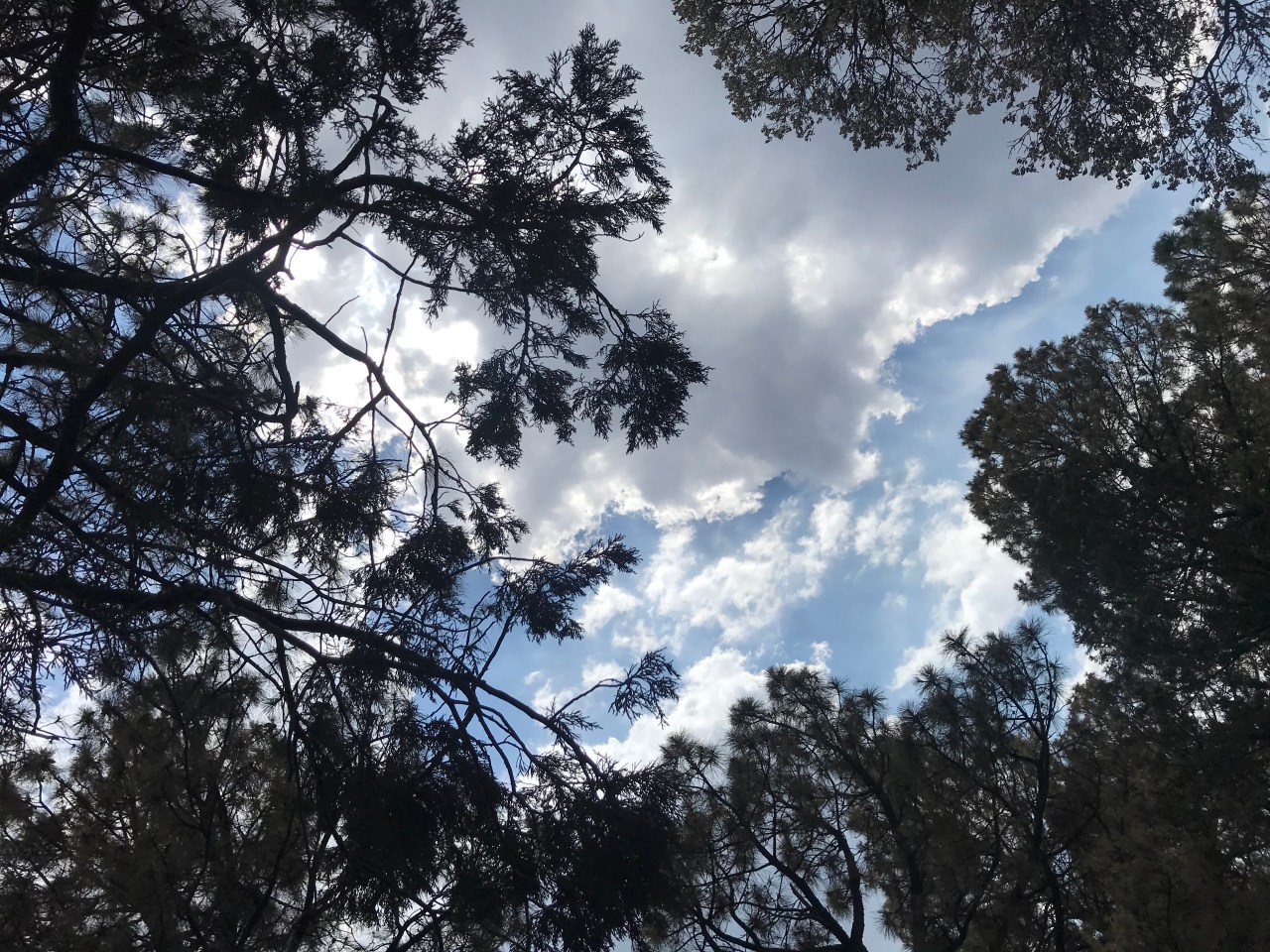
About the feature photo: This photo was taken six days after the fire. It is a peering view beyond scorched tree leaves towards the first set of clouds that came through post-fire. Clouds which did not grow heavy enough for rain. Left to the mercy of El Nino this year, it has remained this way thus far. Risks remain…
For returning TWN guests, I am still trying to regain some momentum and inspiration to write more on diverse topics, but unfortunately this is been a heavy occupation as of late. Thank you for your patience.
 The Wandering Naturalist
What a nightmare!!! I hope your message will get out!
So good to hear from u.
Sent from my iPhone
>
LikeLike